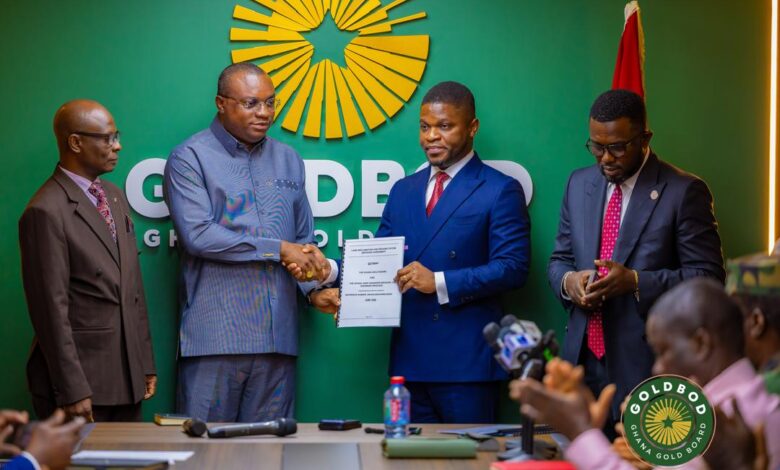
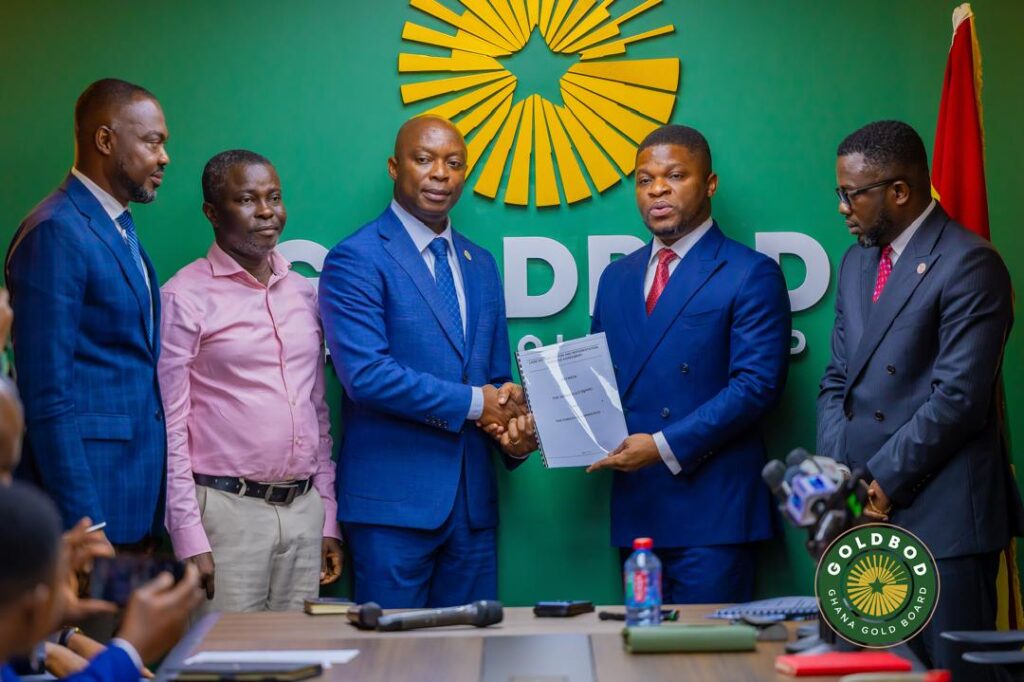
The Ghana Gold Board (GoldBod) has signed a landmark agreement with the Ghana Armed Forces (GAF) and the Forestry Commission (FC) to reclaim and restore degraded lands within the Tano-Nimri Forest Reserve, in a major step toward reversing the environmental destruction caused by illegal mining activities.
The agreement, signed by senior officials of the three institutions, seeks to rehabilitate lands ravaged by illegal mining, particularly the destruction of vegetation and the degradation of forest ecosystems.
Speaking at the signing ceremony, Chief Executive Officer of GoldBod, Mr. Sammy Gyamfi, said the Board, established by law in 2025 to regulate and support Ghana’s gold trading industry, also carries sustainability responsibilities, including land reclamation.
According to him, while legitimate large-scale and artisanal small-scale mining contribute significantly to the national economy, illegal mining popularly known as galamsey has left vast tracts of land devastated.
He stressed that GoldBod’s reclamation programme is designed to deliver practical and transparent restoration under strict legal oversight rather than serve as a mere administrative exercise.
Mr. Gyamfi disclosed that GoldBod has engaged the Engineer Regiment of the Ghana Armed Forces through the Ministry of Defence to undertake civil engineering works, including backfilling, grading, reshaping, compaction and site stabilisation.
He explained that the selection of the Tano-Nimri Forest Reserve followed joint inspections conducted by the Forestry Commission and the Ministry of Lands and Natural Resources, which revealed the extent of environmental degradation and the urgent need for intervention.
The GoldBod CEO acknowledged concerns that land reclamation efforts have in the past been used as a cover for continued illegal mining.
However, he assured that the partnership’s structure and clear separation of roles among the institutions would guarantee genuine restoration under state supervision.
Under the agreement, the Ghana Armed Forces will be responsible for engineering rehabilitation works, while the Forestry Commission will oversee afforestation, vegetation restoration and authorisation processes in line with its custodial mandate over the reserve.
GoldBod will provide funding and project supervision to ensure transparency and accountability.
The agreement is expected to take effect on July 1, 2026, with detailed work plans to be submitted and mobilisation supported through initial payments.
Mr. Gyamfi disclosed that the first phase of the project will focus on Compartment 161 of the Tano-Nimri Forest Reserve, covering 50 hectares out of an estimated 200 hectares of degraded land in the area.
He said the civil engineering component is estimated at approximately GH¢27.9 million, while afforestation and related activities will cost about GH¢7.2 million over a 10-year period.
Of this amount, about GH¢2.2 million is expected to be spent during the initial phase, likely spanning 2026 and part of 2027.
Overall, the pilot project is projected to cost about GH¢36.35 million and is being implemented as part of GoldBod’s Environmental, Social and Governance (ESG) and corporate social responsibility initiatives.
Deputy Minister for Defence, Mr. Ernest Brogya Genfi, described the partnership as a balanced approach to combating illegal mining by combining preventive enforcement with active restoration of already degraded lands.
He stressed that while halting further destruction is essential, restoring damaged ecosystems remains equally important, adding that strict standards and discipline would guide implementation to ensure legality and accountability.
Mr. Genfi further noted that the Tano-Nimri project is intended as a pilot initiative that could be replicated in other degraded forest reserves across the country.
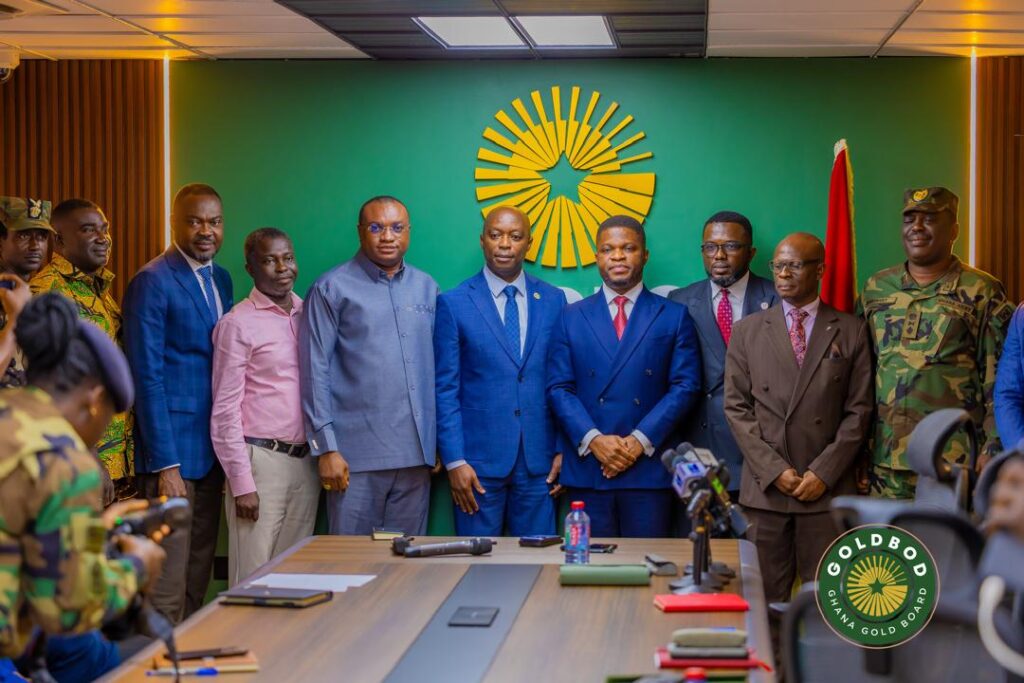
Chief Executive Officer of the Forestry Commission, Mr. Hugh Charles Agyeman-Brown, said the Commission had earlier engaged several institutions on forest restoration efforts, with GoldBod being the first to move beyond discussions to concrete action.
According to him, physical inspections of the site by stakeholders accelerated the signing of the agreement and laid a clear path for implementation.
He praised the involvement of the military, noting that its engineering expertise and professionalism could help overcome operational challenges that have previously hindered reclamation projects.
The three institutions emphasised that the initiative goes beyond merely reclaiming mined-out lands.
It aims to restore ecological integrity, rehabilitate degraded landscapes and ensure that restoration efforts are not exploited as a guise for continued illegal mining.
With implementation set to commence in July 2026, the partnership is being hailed as a structured state response to the environmental scars left by illegal mining and could serve as a model for restoring degraded landscapes across Ghana.