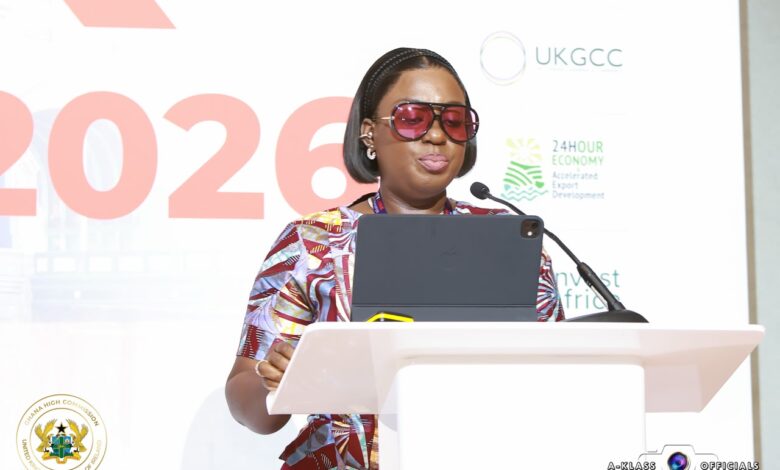
The Ghana Medical Trust Fund (GMTF) has intensified efforts to attract international support for its life-saving healthcare interventions, using the ongoing Ghana-UK Investment Summit in London to showcase the Fund’s growing impact and long-term vision for healthcare delivery in Ghana.
Leading the campaign was the Fund’s Administrator, Adjoa Obuobia Darko-Opoku, who highlighted the transformative outcomes achieved since the Fund’s establishment and appealed to development partners, investors, philanthropists, corporate organisations and the Ghanaian diaspora to support the initiative.
Addressing participants at the summit, Ms. Darko-Opoku pointed to the remarkable recovery of three-year-old Delshad Alukure as one of the clearest examples of the Fund’s impact.
Born with two life-threatening heart conditions — Double Outlet Right Ventricle (DORV) and Patent Ductus Arteriosus (PDA) — Delshad faced a difficult future as his family struggled to raise more than GH¢150,000 required for a life-saving surgery.
With the family unable to afford the treatment, hope appeared to be fading until the Ghana Medical Trust Fund intervened through its pilot support programme.
The financial assistance enabled Delshad to undergo the complex surgery successfully. Less than two months after the procedure, he is now healthy, active and looking forward to a brighter future.
Speaking on the significance of the intervention, Ms. Darko-Opoku said Delshad’s recovery demonstrates how targeted healthcare support can save lives and protect families from financial hardship.
“Delshad is not alone,” she noted.
According to her, every patient supported by the Fund represents a family protected from financial catastrophe, a life saved and a community strengthened.
She explained that thousands of Ghanaian families continue to battle chronic non-communicable diseases such as cancer, kidney disease, cardiovascular conditions, diabetes and stroke, with many households pushed into severe financial distress by the high cost of treatment.
Established to ensure that access to specialised healthcare is determined by medical need rather than financial capacity, the Ghana Medical Trust Fund has since pursued an ambitious agenda centred on patient support, healthcare infrastructure development, specialist workforce training and medical research.
Ms. Darko-Opoku revealed that one of the Fund’s earliest initiatives was a nationwide assessment of Ghana’s healthcare system, which uncovered major gaps in specialist care, diagnostic services, medical equipment and treatment infrastructure.
The findings prompted immediate interventions.
Since then, the Fund has facilitated the distribution of critical medical equipment, including dialysis machines, intensive care unit beds and patient monitors to healthcare facilities across the country.
The Fund is also spearheading the establishment of three modern cardiology centres at Korle Bu Teaching Hospital, Komfo Anokye Teaching Hospital and Tamale Teaching Hospital to strengthen Ghana’s capacity to diagnose and treat cardiovascular diseases.
Beyond infrastructure development, the Trust Fund is supporting the training of specialist healthcare professionals through strategic partnerships with key medical institutions to ensure patients across all regions have greater access to quality care.
As part of its pilot phase, the Fund has already supported 50 patients nationwide, financing critical interventions including heart surgeries, brain surgeries, chemotherapy, radiotherapy and other specialised treatments.
For many beneficiaries, the assistance has represented the difference between life and death.
For families such as Delshad’s, it has restored hope where despair once prevailed.
While highlighting these achievements, Ms. Darko-Opoku stressed that much more remains to be done.
The Fund’s long-term vision includes expanding specialist healthcare services nationwide, increasing access to advanced diagnostic technologies, strengthening cancer treatment centres and ensuring that no Ghanaian is denied essential healthcare because of financial constraints.
She therefore called for stronger international partnerships and investment support to help scale the initiative and deepen its impact across the country.
As Delshad’s story continues to inspire many, the Ghana Medical Trust Fund believes it offers a glimpse into what is possible when financial barriers to healthcare are removed.
For the growing number of beneficiaries across Ghana, the Fund is doing far more than paying medical bills — it is providing a second chance at life.