StarOil Pushes Discounted Fuel Pricing at Night
…As Calls Grow For Suspension Of Some Petroleum Levies

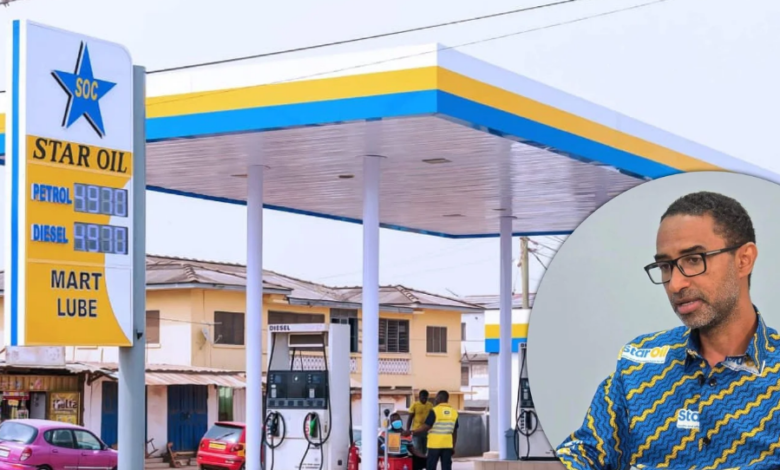
The Chief Executive Officer (CEO) of StarOil Ghana, Philip Kwame Tieku, has proposed discounted fuel pricing at night as a key component of the government’s flagship 24-hour economy policy.
Mr. Tieku stated that his company has automated systems capable of implementing such a pricing model efficiently, arguing that it would make life more comfortable for customers and Ghanaians at large.
“24-hour economy needs discounted fuel pricing at night as a critical component. StarOil has automated systems to make this work. Others don’t, and that is why they are against that flexibility,” he said.
In a Facebook post on March 21, Mr. Tieku described the proposal as a matter of “policy consistency,” explaining that lower fuel prices at night—particularly for diesel, could encourage commercial drivers to operate during off-peak hours.
“For example, if diesel prices are lower at night, drivers of commercial haulage trucks, both big and small, may decide to work at night to support the nighttime economy, with the added benefit of reducing costly daytime traffic,” he noted.
The proposal has since received significant public support, with many social media users praising it as a practical measure that could ease economic pressures and improve efficiency.
His proposal comes amid increasing calls for suspension of some petroleum levies such as the Bulk Oil Storage and Transportation Company Limited (BOST) levy, and others in response to rising fuel prices.
Mr. Tieku also raised concerns about fuel pricing dynamics in Ghana, particularly in relation to global oil price trends.
He argued that even if international prices fall—especially following a potential end to tensions in the Middle East involving Iran, Israel and the United States—local price regulations could delay the transmission of those benefits to consumers.
“When the war ends, prices will fall sharply on the world market, but in Ghana there will be a price floor that delays passing on that benefit to consumers. Everywhere else, the concern is about high fuel prices—why is Ghana concerned about low prices?” he questioned.
He further queried the economic cost of restricting oil marketing companies from offering discounted diesel prices in strategic locations, such as high-volume farming and market areas, where lower fuel costs could reduce production and transportation expenses.
“What is the cost to the economy when OMCs cannot provide discounted diesel prices in selected high-volume farming or market locations to reduce input costs?” he asked.
Addressing concerns about pricing practices, Mr. Tieku rejected suggestions of predatory pricing, insisting that StarOil remains profitable under its current model.
“If we were engaged in predatory low pricing with the aim of becoming a monopoly, we would not be so profitable. The regulator has our financials and knows we are probably the most profitable indigenous OMC,” he stated.
Calls to Suspend Petroleum Levies
Meanwhile, the Executive Director of the Africa Centre for Energy Policy (ACEP), Benjamin Boagye, has called for the suspension of some petroleum levies, including the Bulk Oil Storage and Transportation Company Limited (BOST) levy, in response to rising fuel prices.
Speaking on Joy FM on Wednesday, April 1, Mr. Boagye suggested that the BOST margin could be temporarily suspended as government reviews and optimises its fiscal space.
“The BOST margin can be suspended while we think about optimising that space,” he said.
He explained that although BOST operates within a commercial framework, it benefits from state support, raising concerns about the continued imposition of levies on consumers during difficult economic conditions.
“BOST is essentially a commercial enterprise at this point, competing with private depots and other investors. We have provided the infrastructure, and I don’t see the reason why consumers should continue to pay a margin for its operations when people are already struggling,” he argued.
Mr. Boagye added that suspending such levies could provide immediate relief to consumers while broader policy measures are considered to strengthen fuel distribution.
Fuel Prices Rise
Fuel prices have increased at the pumps as major oil marketing companies adjust their rates ahead of the first pricing window for April.
The adjustments reflect compliance with the National Petroleum Authority’s (NPA) new price floor, as well as upward pressure from global market trends driven largely by geopolitical tensions.
State-owned GOIL was among the first to implement the new pricing structure.
Petrol is now selling at GH¢13.30 per litre, up from GH¢12.24, while diesel has risen to GH¢17.10 per litre from GH¢15.69.
Under the new NPA price floor, petrol is pegged at a minimum of GH¢13.30 per litre, diesel at GH¢17.10 per litre, and Liquefied Petroleum Gas (LPG) at GH¢10.71 per kilogram.
More oil marketing companies are expected to adjust their prices in line with the new pricing regime in the coming days.