Running-Mate Slot Is Not Apprenticeship – Grassroots Question Dr. Afriye’s Suitability
…NPP Grassroots Question Dr. Ayew Afriye’s Suitability

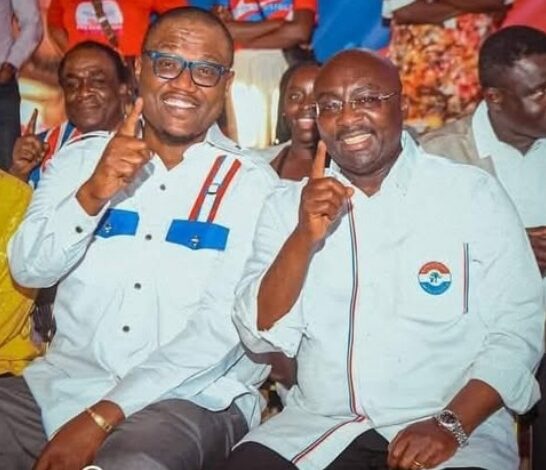
Some members of the New Patriotic Party (NPP) have questioned the suitability of the Member of Parliament (MP) for Effiduase-Asokore, Dr Nana Ayew Afriye, for consideration as running mate to the party’s flagbearer, Dr Mahamudu Bawumia.
The critics argue that the position requires a candidate with a demonstrable record of leadership, executive experience and electoral appeal, insisting that the party cannot afford to nominate someone who would have to learn on the job.
One of those raising concerns is Mr Gideon Kwasi Annor, an NPP member in the Abuakwa South Constituency, who has questioned the basis for promoting Dr Ayew Afriye’s candidature.
In an opinion article titled “Nana Ayew Afriye for Running Mate? The NPP Must Be Serious,” cited by The Archives, Mr Annor argues that the party must prioritise competence, strategic value and national electoral considerations in selecting a running mate.
He maintains that the NPP should focus on holding the John Mahama-led government accountable and rebuilding its electoral fortunes ahead of the 2028 general election, rather than allowing internal ambitions to dominate the political conversation.
Government’s Record Should Be the Priority
Mr Annor argues that the NPP has completed major internal organisational processes, including the election of Dr Bawumia as flagbearer and the selection of party officers from the polling-station level to the national executive.
He says the party should now concentrate on scrutinising the government’s handling of key national issues, including illegal mining, the 24-hour economy, job creation, electricity tariffs, fuel prices and the cost of living.
He also cites concerns about the cocaine menace, border security, youth unemployment, access to secondary education and allegations of selective application of state power.
According to him, the party must use these issues to challenge the government and present a credible alternative to Ghanaians ahead of the next election.
However, he contends that discussions about Dr Ayew Afriye’s possible elevation to the vice-presidential slot risk diverting attention from that objective.
Mr Annor questions whether the reported campaign for the Effiduase-Asokore MP is being driven by the MP himself or by supporters seeking to build momentum around his name.
He insists that the running-mate position should not be treated as a reward for political loyalty, a consolation prize or an opportunity for an aspirant to acquire experience.
Health Committee Leadership Under Scrutiny
A major part of Mr Annor’s argument centres on Dr Ayew Afriye’s performance as Ranking Member of Parliament’s Health Committee.
He argues that the position offers the MP an important platform to scrutinise government health policies, examine expenditure, expose administrative shortcomings and demand accountability from the Ministry of Health.
However, Mr Annor questions whether Dr Ayew Afriye has demonstrated the level of parliamentary oversight and political assertiveness expected of someone occupying that position.
He asks whether the Minority has exerted sufficient pressure on Health Minister Kwabena Mintah Akandoh and whether the party has adequately exploited weaknesses in the government’s management of the health sector.
Mr Annor also raises questions about claims circulating among party members concerning a hospital associated with Dr Ayew Afriye and reports that newly recruited security-service personnel are directed to undertake mandatory medical examinations at the facility.
He calls for clarification on whether such an arrangement exists, the nature of any contractual or administrative relationship involved, and whether it could create an actual or perceived conflict of interest.
The article, however, does not establish that any wrongdoing has occurred. Mr Annor argues that the questions warrant clear answers in view of the public responsibilities attached to the MP’s position and the possibility of his elevation to a higher political office.
He further challenges Dr Ayew Afriye to demonstrate that he has discharged his parliamentary oversight responsibilities independently and effectively.
Mr Annor also poses a question about the confidence of Minority members serving on the Health Committee, asking whether they would choose Dr Ayew Afriye as their ranking member if the position were contested afresh.
He argues that an aspirant seeking the vice-presidential nomination must demonstrate an ability to challenge ministers, articulate policy positions and command public confidence.
Lightwave Project Questions
Mr Annor also calls for clarity on questions reportedly raised during the Eighth Parliament concerning the Lightwave project, when Dr Ayew Afriye chaired the Health Committee.
He refers to allegations involving payments said to have been made to parliamentary figures and mentions an individual identified as Dzaba, who, according to the article, featured in accounts surrounding the controversy.
Mr Annor poses questions about whether Dr Ayew Afriye knew Dzaba or had any dealings or discussions with him concerning the project.
He also asks what transpired regarding the project, whether concerns were raised about payments or procurement, and whether relevant records exist to establish the facts.
The article further raises questions about whether Mr Akandoh, who served as Ranking Member at the time, had any role in the matters being discussed.
These claims remain allegations in the article and are not established findings of wrongdoing. Mr Annor maintains that the individuals concerned should have an opportunity to clarify their positions and provide verifiable evidence.
He argues that the NPP must neither rely on rumours nor ignore legitimate questions when considering candidates for important national positions.
According to him, any unresolved concerns about an aspirant’s record should be addressed before the party considers elevating that person to the vice-presidential slot.
‘What Executive Experience Does He Bring?’
Mr Annor identifies executive experience as another key consideration in assessing Dr Ayew Afriye’s suitability for the position.
He argues that, to the best of his knowledge, the MP has not served as a substantive minister or deputy minister, raising questions about his experience in executive administration.
Although acknowledging that the absence of ministerial experience does not automatically disqualify an individual from higher office, Mr Annor insists that a running mate must demonstrate readiness to contribute to national policymaking and assume greater responsibilities when necessary.
He asks what major national programmes Dr Ayew Afriye has administered, what ministerial responsibilities he has handled and what evidence demonstrates his ability to manage budgets, institutions and competing public expectations.
Mr Annor cites the professional and public-service backgrounds of several individuals who have occupied Ghana’s vice-presidential position or served on presidential tickets.
These include former President John Evans Atta Mills, former President John Dramani Mahama, the late Paa Kwesi Amissah-Arthur, Professor Jane Naana Opoku-Agyemang and Dr Bawumia.
He argues that their professional, institutional or executive records provided important foundations for their respective political careers.
Mr Annor also points to Dr Bawumia’s selection as the NPP’s running mate in 2008, citing his background in economics, his service as Deputy Governor of the Bank of Ghana and his experience in international economic policy.
According to him, the selection offered a strategic complement to the presidential candidate at the time.
He stresses, however, that prospective running mates need not follow identical career paths but must demonstrate what distinctive value they would bring to the ticket.
Mr Annor consequently challenges Dr Ayew Afriye’s supporters to explain what sets him apart from other potential candidates with stronger executive records, broader national reach or greater electoral appeal.
He argues that loyalty to Dr Bawumia, on its own, cannot constitute sufficient grounds for the nomination.
Electoral Considerations Matter
Mr Annor further argues that the NPP must carefully assess the electoral implications of its running-mate choice, including geographical representation, voter perceptions and the ability of a candidate to complement the flagbearer.
He questions what additional electoral advantage Dr Ayew Afriye would bring to the ticket and which constituencies the party could realistically expect to become more competitive through his selection.
The article also discusses the MP’s family background, stating that his mother is from the Kotokoli community while his father is from Akropong in the Eastern Region.
Mr Annor argues that the party must consider how voters across the Eastern, Ashanti, Central, Greater Accra and other regions would perceive the composition of the ticket.
He cautions, however, against treating regional origin as the sole basis for determining a candidate’s suitability.
Rather, he maintains that those advocating for Dr Ayew Afriye must demonstrate how his selection would broaden the NPP’s electoral appeal and strengthen its chances of winning the 2028 election.
For him, claims of loyalty, availability or personal ambition cannot replace a convincing assessment of a candidate’s record and strategic value.
NPP Must Stay Focused
Mr Annor concludes that the NPP must remain focused on rebuilding the party, scrutinising the government and developing a credible alternative ahead of the 2028 elections.
He argues that the party should not allow individual ambitions or campaigns by supporters to dictate the running-mate debate before the merits of prospective candidates have been properly assessed.
He also maintains that Dr Bawumia should be allowed to make his choice based on merit, compatibility, electoral strategy and the national interest, without being pressured by campaigns designed to create expectations around particular aspirants.
Mr Annor urges Dr Ayew Afriye to concentrate on his responsibilities as Ranking Member of Parliament’s Health Committee, demonstrate the effectiveness expected of him and contribute meaningfully to the party’s efforts to return to power.
He insists that any consideration of the MP for the running-mate position must be based on a demonstrable record rather than speculation or self-promotion.
“The running-mate conversation must be earned, not manufactured,” Mr Annor argues.
He says the central question is not whether Dr Ayew Afriye wants the position, but whether the NPP can present a compelling case to Ghanaians for his selection.
On the issues raised in his article, Mr Annor maintains that the case for the Effiduase-Asokore MP’s candidature has yet to be convincingly established.