Ambulance Shortage Crisis Hits C/R; Only 3 Functional Vehicles Serving Several Districts


A critical shortage of ambulances is reportedly hampering emergency service delivery in the Central Region, with only three operational vehicles currently available to serve several districts and communities.
Information gathered by The Archives indicates that several ambulances operated by the National Ambulance Service (NAS) in the region have been grounded due to mechanical faults, while others have reportedly been involved in accidents.
The development is said to be putting enormous pressure on the few functional ambulances and personnel, as they are compelled to respond to emergencies across wide geographical areas.
Sources told The Archives that, apart from Cape Coast township, there is no operational ambulance available along highway stretching to Accra, raising concerns about timely emergency response in the event of accidents and other medical emergencies.
The situation, has reportedly left emergency control-room personnel struggling to respond to distress calls when no ambulance is immediately available for dispatch.
According to sources, the increasing number of emergency cases, coupled with the limited number of functioning vehicles, has created significant operational challenges for the Service in the region.
The shortage is, however, not limited to the Central Region, as similar concerns have also emerged in parts of the Volta and Bono regions, as well as other districts across the country.
It remains unclear whether management is engaging the government on the procurement of additional ambulances to augment the existing fleet.
Move to Restore Grounded Vehicles
The concerns come at a time when the NAS management is undertaking a nationwide fleet-restoration programme aimed at returning grounded ambulances to active service.
The initiative, dubbed “Operation Restore Fleet,” seeks to reduce vehicle downtime, repair grounded ambulances and improve fleet management across the country.
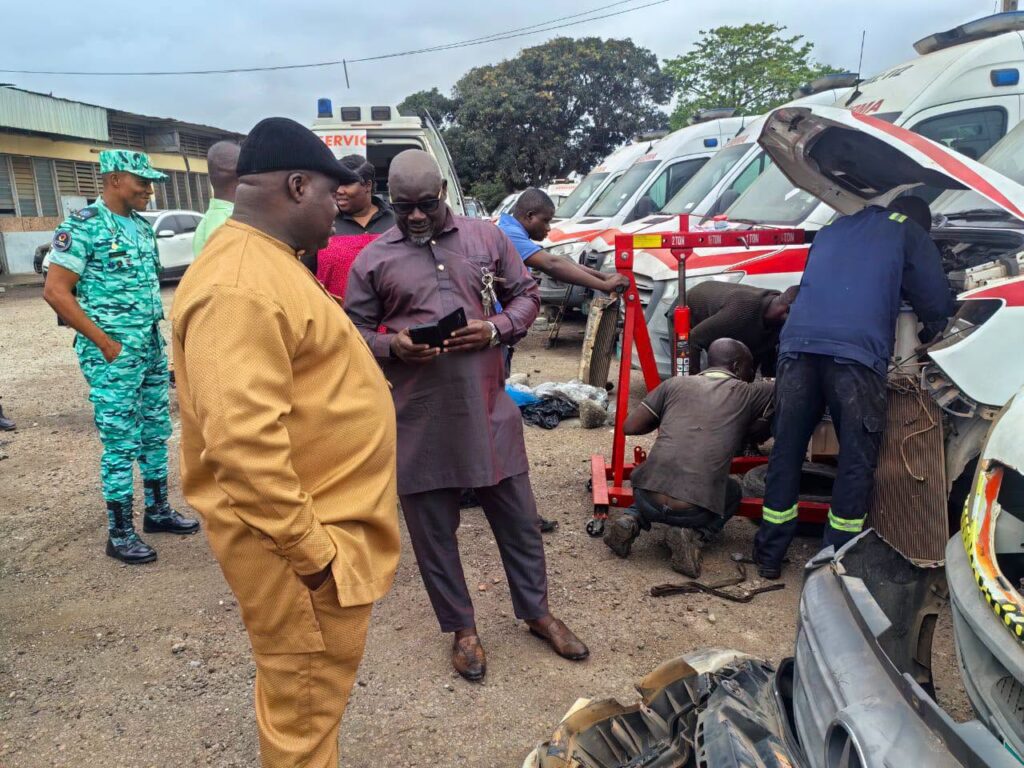
The Chief Executive Officer (CEO) of the NAS, Dr George Kojo Owusu, recently inspected ongoing repair works at the Service’s Central Workshop at Korle-Bu to assess progress under the initiative.
Dr Owusu, who led a team of management officials on the working visit, expressed satisfaction with the progress of work and commended technicians and engineers for their commitment to restoring the grounded vehicles.
He said the operation remained on course and was already yielding positive results.
As part of the exercise, serviceable ambulances are being separated from unserviceable ones to improve workshop efficiency, streamline maintenance and strengthen fleet management.
Management has also introduced fleet management software to improve vehicle monitoring, maintenance scheduling and decision-making on the deployment and servicing of ambulances.
Additional security measures, including the installation of Closed-Circuit Television (CCTV) cameras, are also being implemented at the workshop to protect assets and improve accountability.
According to the NAS, the restoration exercise is focused largely on ambulances that developed major mechanical faults after about six years of intensive nationwide service.
The objective is to repair and return as many vehicles as possible to active duty while identifying ambulances that have become beyond economic repair for appropriate management.
Dr Owusu also acknowledged the role of the media in promoting accountability and ensuring that public institutions remain responsive to citizens.
He, however, called for accurate and balanced reportage on emergency medical services, noting the difficult conditions under which NAS personnel operate and the large volume of emergency cases handled daily.
The fleet-restoration programme is expected to improve the operational readiness of the Service and strengthen emergency medical response nationwide.