The Chief Executive Officer of the Minerals Income Investment Fund (MIIF), Mrs. Justina Nelson, has called for stronger collaboration, smarter regulation, and catalytic African capital to unlock the next wave of mining projects on the continent.
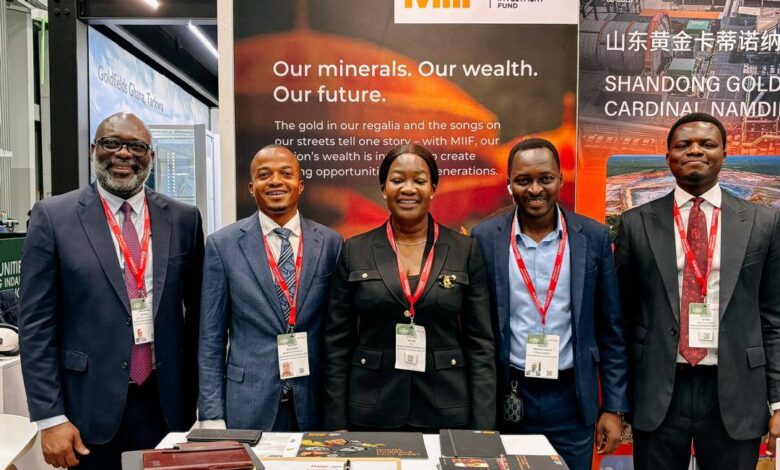
She made these remarks at a CEO Roundtable Discussion held during the Ministerial Symposium of the African Mining Indaba 2026, on Sunday, 8 February 2026, at the Cape Town International Convention Centre (CTICC) in Cape Town, South Africa.
The high-level session, themed “Financing a New Wave of Mining Projects in Africa – Innovation, Regulation & Collaboration,” brought together policymakers, sovereign wealth fund leaders, investors, and industry executives to examine how Africa can develop bankable, scalable, and sustainable mining projects.
Mrs. Nelson participated in the discussion alongside Yakubu Mohammed, MP for Ahafo Ano South and a Member of MIIF’s Governing Board and Mr. Kwabena Barning, the Chief Technical Officer of MIIF.
Addressing Financing Barriers in African Mining
Contributing to discussions on financing early-stage mining projects, the MIIF CEO highlighted key challenges facing the sector, including geopolitical risks, regulatory uncertainty, infrastructure deficits, and weak project pipelines.
She noted that while global capital is available, Africa faces a shortage of bankable, investment-ready mining projects, particularly at the early stages. Mrs. Nelson stressed the importance of sovereign wealth funds and development finance institutions playing a catalytic role by taking early positions to de-risk projects and crowd in private investment.
“There is no shortage of capital globally. What Africa needs are de-risked, feasibility-ready projects that investors can confidently support,” she emphasised.
Role of African Institutional Capital
Mrs. Nelson underscored the critical role African institutional investors, such as sovereign wealth funds and pension funds can play as strategic co-investors rather than dominant players. According to her, institutions like MIIF bring long-term capital, governance discipline, and credibility that help improve project bankability and investor confidence.
She further highlighted the importance of structured partnerships, platform investments in shared infrastructure, and blended financing models to support sustainable mining development without distorting markets.
Digitalisation, AfCFTA and Regional Value Addition
The MIIF CEO also pointed to digital cadastral systems and transparent geological data as essential tools for attracting exploration capital and reducing investment risk. She cited Ghana’s policy reforms, including the removal of VAT on exploration inputs, as examples of how regulatory clarity can stimulate investor interest.
On regional integration, Mrs. Nelson emphasised the opportunities presented by the African Continental Free Trade Area (AfCFTA) to harmonise standards, pool infrastructure, and develop regional processing hubs that are economically viable and attractive to large-scale investors.
Strengthening Public–Private Collaboration
Discussions at the roundtable further focused on effective public–private partnership models. Mrs. Nelson advocated a pragmatic risk-sharing framework where governments assume infrastructure and regulatory risks, while private investors focus on operational and technological execution.
She highlighted successful examples from Ghana, including power infrastructure partnerships that have improved the bankability of mining and processing projects.
MIIF’s Commitment
The participation of MIIF at the African Mining Indaba 2026 reinforces the Fund’s commitment to maximising the value of Ghana’s mineral wealth, supporting sustainable mining investments, and advancing Africa’s broader industrialisation agenda.