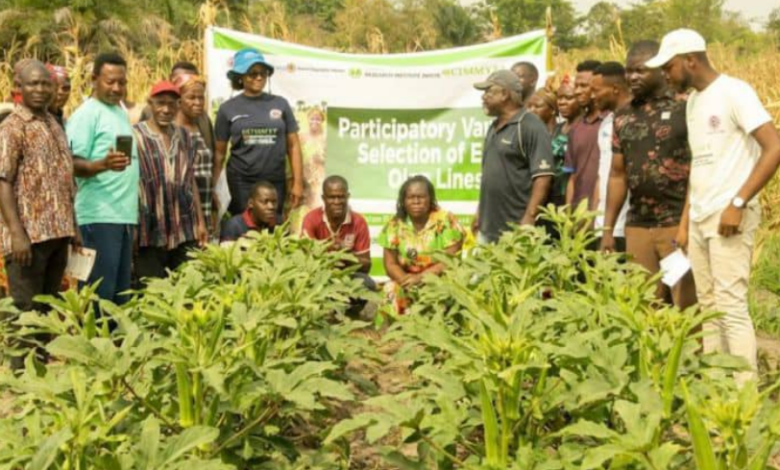
The Council for Scientific and Industrial Research–Crops Research Institute (CSIR-CRI) has conducted a Participatory Varietal Selection (PVS) exercise for improved okra lines in the Adaklu District of the Volta Region.
The exercise, held at Adaklu-Waya, forms part of the Vision for Adapted Crops and Soils–Breeding: Okra-Ghana (VACS-Breeding: Okra-Ghana) project.
It is funded by the International Maize and Wheat Improvement Centre (CIMMYT) through the World Vegetable Centre (WorldVeg) and implemented in collaboration with CSIR-CRI, Ghana, and the National Horticultural Research Institute (NIHORT), Nigeria.
The PVS brought together farmers, traders, consumers, seed companies, extension officers and other agricultural practitioners to evaluate 55 advanced okra breeding lines under real field conditions.
Participants assessed the lines based on key traits including fruit size, colour, yield potential, uniformity and market appeal.
Unlike conventional breeding approaches that are largely researcher-driven, the PVS method actively involves end-users in the selection process.
This ensures that okra lines advanced for release are not only high-yielding and climate-resilient but also aligned with farmer needs, consumer preferences and market demands.
Speaking to the Ghana News Agency, Dr Jacinta Adoma Opoku, an okra breeder and Research Scientist at CSIR-CRI, said the PVS approach was critical to improving adoption rates of new varieties.
She noted that past breeding programmes had shown that even high-performing varieties could fail if user preferences were not considered early.
The PVS process, she explained, bridges this gap by allowing farmers, traders and consumers to directly influence which okra lines are advanced for future release in Ghana. During the field walk, farmers identified varieties suitable for their local farming conditions and production systems.
They said early exposure to improved lines would support better production decisions, reduce risks and potentially increase incomes.
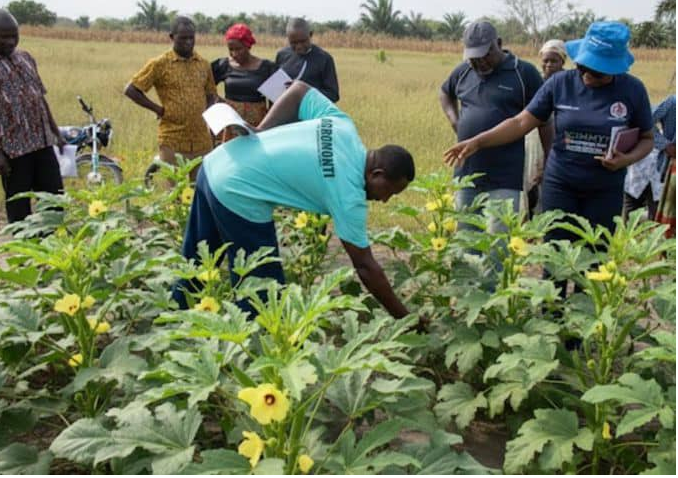
Traders assessed fruit traits related to size, colour and appearance to determine market appeal, while consumers confirmed preferences for attractive and uniform produce. Seed companies also identified okra lines with strong commercial potential for future seed multiplication and distribution.
Stakeholder feedback from the evaluations is expected to reduce uncertainty around future demand and support more reliable investment decisions in seed promotion.
Beyond agronomic performance, the PVS provided breeders with insights into traits valued by households and markets, enabling them to prioritise varieties with high adoption potential and avoid those with weak market acceptance.
By testing okra varieties across multiple environments, including Adaklu-Waya, and planned sites in Benin and Nigeria, the VACS project is contributing to the development of climate-resilient and nutrition-sensitive crops suited to diverse soil and climatic conditions in Ghana and the wider West African sub-region.
The exercise highlighted the value of strong partnerships among CIMMYT, WorldVeg, CSIR-CRI and NIHORT, and demonstrated how inclusive, demand-driven breeding can shape the future of okra from farmers’ fields to consumers’ tables.
Source: GNA