LHIMS Contractor Overpaid $30 Million for No Work Done
…Minister Announces State-Owned Digital System after Blackmail Tactics Failed

An extensive forensic and technical audit into the operations of the Lightwave Health Information Management System (LHIMS) has uncovered major contractual, technical, and data management breaches, leading to alleged overpayments of more than $30 million to the contractor for unverified work and hardware supplies.
The LHIMS platform, a privately owned digital health system, was originally tasked with managing patient information across Ghana on behalf of the government.
According to the audit, there were significant shortages and quality issues in hardware deliveries and installations, exposing the state to an estimated $29 million in unaccounted or substandard supplies.
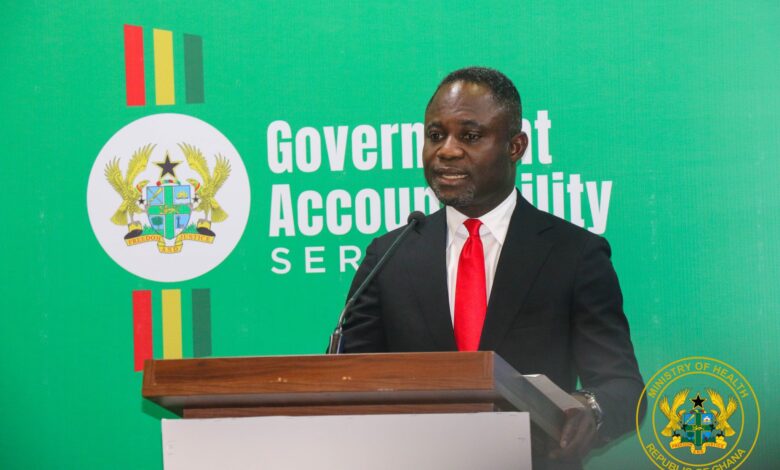
Speaking at the Government Accountability Series held yesterday October 29, the Minister of Health, Kwabena Mintah Akandoh, accused the company behind LHIMS of gross underperformance and “blackmail tactics.”
The Minister alleged that the vendor refused to hand over administrative access and Ghana’s health data to the state, leading to repeated service disruptions and data blackouts.
“The vendor’s refusal to release administrative rights to the government, resulting in data blackouts, is pure blackmail,” he said.
GHIMS to Replace LHIMS
To address the lapses and ensure continuity of care, the Ministry has developed and deployed the Ghana Health Information Management System (GHIMS) — a fully state-owned and managed digital platform.
The new system introduces a National Health Information Exchange, a secure integration framework designed to prevent any single vendor from monopolizing Ghana’s health data.
This exchange will allow multiple digital health service providers to connect under strict regulatory oversight.
GHIMS also integrates seamlessly with the National Health Insurance Authority (NHIA) database, providing real-time access to patient records across the country.
This means that a patient registered in Tamale can now receive care in Accra without the need for re-registration.
Akandoh announced a four-week phased rollout plan beginning with teaching and regional hospitals, followed by district hospitals, polyclinics, health centres, and CHPS compounds.
Audit Findings and Contract Details
The Minister revealed that the forensic audit has been referred to the Attorney-General’s Department and other relevant state security agencies for advice and possible prosecution.
He explained that in 2019, the government signed a $100 million contract with Lightwave to connect 950 health facilities nationwide through LHIMS.
The contract, originally set to end in 2022, was extended twice—first to 2023 and later to December 31, 2024—due to persistent implementation delays.
“At the end of the contract, out of 950 facilities, only 450 had been connected. A three-year contract extended to five years, yet only half the work completed, clearly shows underperformance,” the Minister stated.
Despite the shortfall in delivery, over 70% of the total contract sum had already been paid.
“By December 2024, the vendor had received about $77 million out of the $100 million total. Clearly, more than 70% of the funds were paid, but less than 50% of the work was done,” Mr. Akandoh added.
He further disclosed that the audit uncovered irregularities in hardware supplies, including shortfalls in quantity and poor equipment quality.
“Where the contract specified HP laptops, cheaper brands were supplied. Where 100 computers were expected, fewer were delivered. The gap in hardware value alone exceeded $18 million,” he revealed.
Mr. Akandoh expressed deep concern over the system’s data security and sovereignty, noting that LHIMS’s cloud infrastructure was hosted outside Ghana.
“It is unconscionable for any private company to have access to the medical records of Ghanaians without state control. With the cloud hosted in India, we had to act,” he emphasized.
The Minister added that the government’s immediate priority is to restore stability in public health facilities through the GHIMS platform.
“Even though we had no contract with the vendor at the time, we were ready to sign a maintenance agreement to cover the 450 facilities. But the software itself was not owned by the state. That is why it was called the Lightwave Health Information Management System. We are now taking full control.”
Service Disruptions
In the meantime, disruptions in the LHIMS platform have forced several hospitals to revert temporarily to manual record-keeping. The NHIA has also reported intermittent service downtimes affecting patient services.
The Minister assured the public that these challenges are being resolved as GHIMS takes full effect.
“Ghanaians will never go back to the manual way. We are moving forward responsibly, confidently, and decisively,” he declared.